Aleph Zero
Independent community presentation by EV 0X.

Performance-Engineered.
Proof-Connected.
Community-Driven.

A decentralized public Layer 1 blockchain for building, connecting, and exchanging digital assets, engineered for performance, privacy, and community-led governance.

Subsecond
Time to finality
Current official L1 positioning.
100,000 TPS*
Historical protocol benchmark
*2019 Python proof-of-concept; not current mainnet throughput.
128 Nodes*
Benchmark test environment
*Scale used for the published 100,000 TPS proof-of-concept.
Aleph Zero performance visualization
Live + Proven

Fast finality by design.

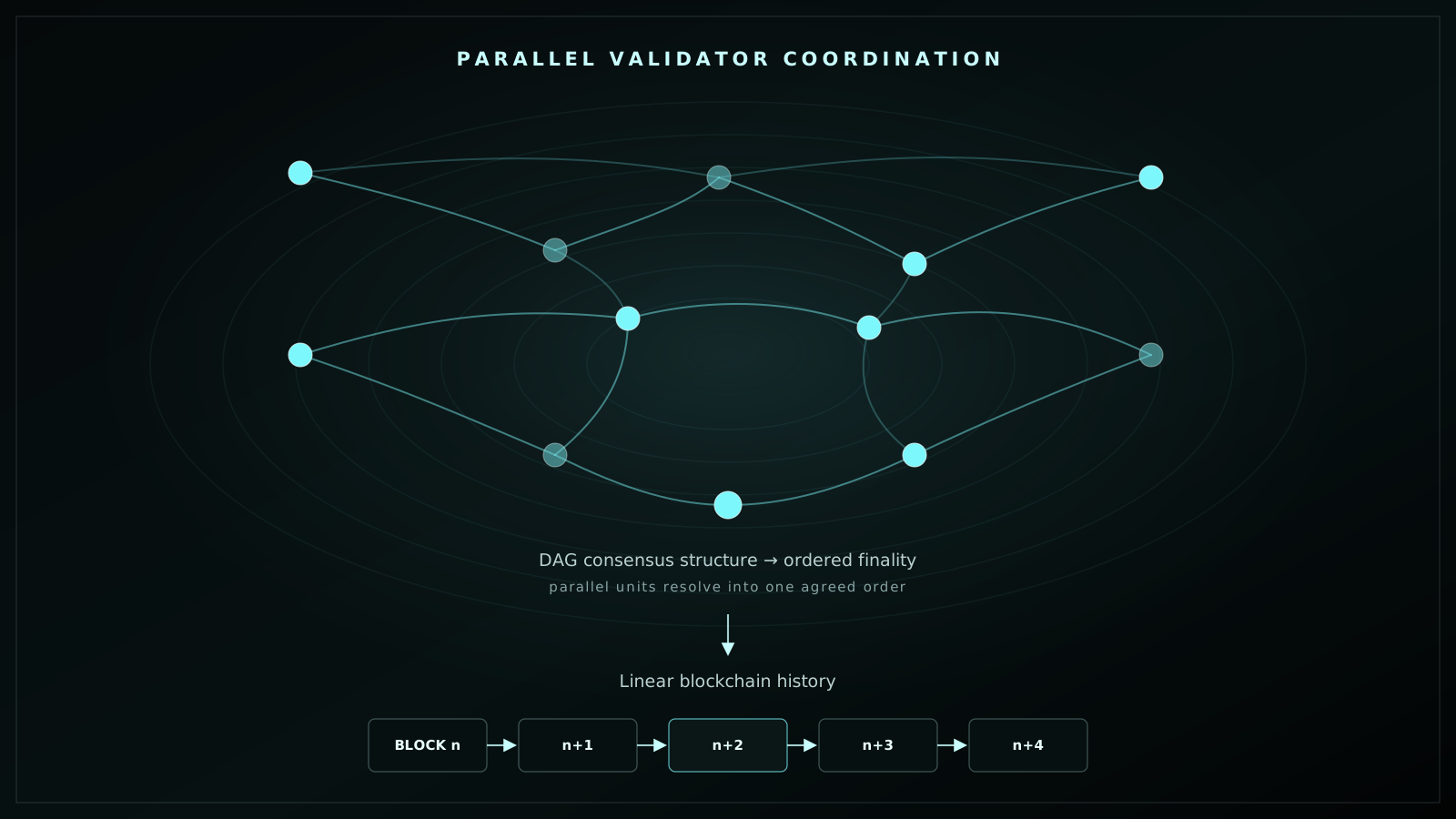
AlephBFT separates rapid consensus from the linear blockchain applications use, allowing validators to coordinate in parallel before blocks settle into one ordered history.
Subsecond finality The current official L1 description emphasizes subsecond time to finality.
100,000 TPS protocol benchmark An early proof-of-concept reached 100,000 transactions per second on 128 nodes; it remains a historical test result, not a mainnet throughput claim.
Deterministic finalization Once finalized, transaction history does not depend on waiting for additional confirmations to become more probable.
AlephBFT DAG consensus structure leading to ordered finality and a linear execution history
Live + Proven

Parallel consensus. Linear state.

Aleph Zero is a blockchain, not a DAG ledger. The DAG acts as a consensus structure: validators can create units concurrently, while the final ordered result remains a conventional blockchain history.

DAG for coordination Validator information can be produced in parallel rather than forced through a single sequential creation path.
Blockchain for applications The resulting ordered history remains linear, preserving the state model expected by applications and smart contracts.
Peer-reviewed AlephBFT The consensus protocol is research-backed, Byzantine fault tolerant, and implemented publicly in Rust.
25,000 AZERO validator minimum Mainnet validator admission is permissionless, subject to the network’s minimum validator bond.
Aleph Zero RISC-V execution visualization
Planned

A new execution path for smart contracts.

The roadmap concentrates future smart-contract development on Aleph Zero L1. ink! 6 and pallet-revive are intended to move contract execution toward RISC-V.

RISC-V execution path Contracts are planned to compile to RISC-V bytecode through the newer ink! environment.
One L1 focus Sunsetting the EVM-compatible L2 removes a parallel environment and concentrates development on the main chain.
Solidity pathway Planned Solidity and Yul compilation could let Ethereum developers target RISC-V without restoring an EVM layer.
Aleph Zero proof-connected bridges visualization
Exploring

Cross-chain connectivity, verified by proof.

The roadmap explores bridges that verify external chain state cryptographically, reducing reliance on a conventional bridge committee.

ZKBridge for smart-contract chains Relayers generate proofs of source-chain state that the destination chain can verify.
BitVM for Bitcoin A separate design is being considered for BTC because Bitcoin does not provide Ethereum-style smart contracts.
Connectivity with purpose Bridged assets become inputs to the market layer rather than ending their journey at the bridge.
Aleph Zero native markets visualization
Planned

Bring assets in. Trade them natively.

The roadmap pairs interoperability with a native limit-order-book exchange, giving bridged and local assets a direct market on Aleph Zero.

Limit-order-book DEX Buyers and sellers place explicit orders at chosen prices instead of relying only on AMM pools.
Price-controlled execution Traders specify the prices they are willing to accept instead of relying on an automated pricing curve.
Privacy as an extension The roadmap identifies privacy-preserving pools using differential privacy as a later market-layer development.
Aleph Zero community governance visualization
Planned

Community governance that can act.

The proposed Swiss Association gives community governance a practical legal interface: it can hold assets, sign contracts, hire providers and interact with institutions.

DAO + Association On-chain governance can direct designated funds while the Association handles real-world legal responsibilities.
Operational Board Members elect a Board to execute budgets, manage agreements and coordinate service providers.
Community-led growth Ambassadors, events and independent initiatives extend participation beyond governance votes.
The road ahead

Focus the core. Expand the network.

Aleph Zero is concentrating development on one stronger Layer 1, expanding trust-minimized connectivity, and transferring more responsibility to its community.

Aleph Zero

Build.
Connect.
Participate.

A high-performance Layer 1 evolving toward modern contract execution, proof-oriented interoperability and community-led stewardship.

Independent community presentation. EV 0X is not operated by or affiliated with the Aleph Zero Foundation. Roadmap items are presented as planned or exploratory where applicable.